Overhyped product, underhyped pattern
Every major computing era has followed the same unwritten contract.
The technology vendor supplies the infrastructure. The customer owns their data. And the business logic, the methods, and know-how that make each company distinct, stay firmly within the customer's walls.
For sixty years, this contract held. Through mainframes, workstations, PCs, client-server, and cloud, the boundaries shifted, but the principle endured. Then the first wave of AI arrived, and the contract broke.
The big AI labs proposed something no previous technology era had dared to ask: send us everything. Your data, your context, your business methods, your proprietary logic. We'll apply intelligence on our terms and return useful results. In exchange, you accept our walled garden, our pricing, and our opaque use of everything you've given us.
That model was never going to survive contact with enterprise reality.
And the viral explosion of OpenClaw, the open-source AI agent that's become the fastest-growing project in GitHub history, is the clearest signal yet that the market has figured this out.
What OpenClaw actually represents
OpenClaw is an open-source AI agent runtime that runs on your local machine. It connects to large language models through APIs, integrates with dozens of tools and services, and lets you automate complex workflows through channels you already use. It collected over 150,000 GitHub stars faster than any project in GitHub's history.
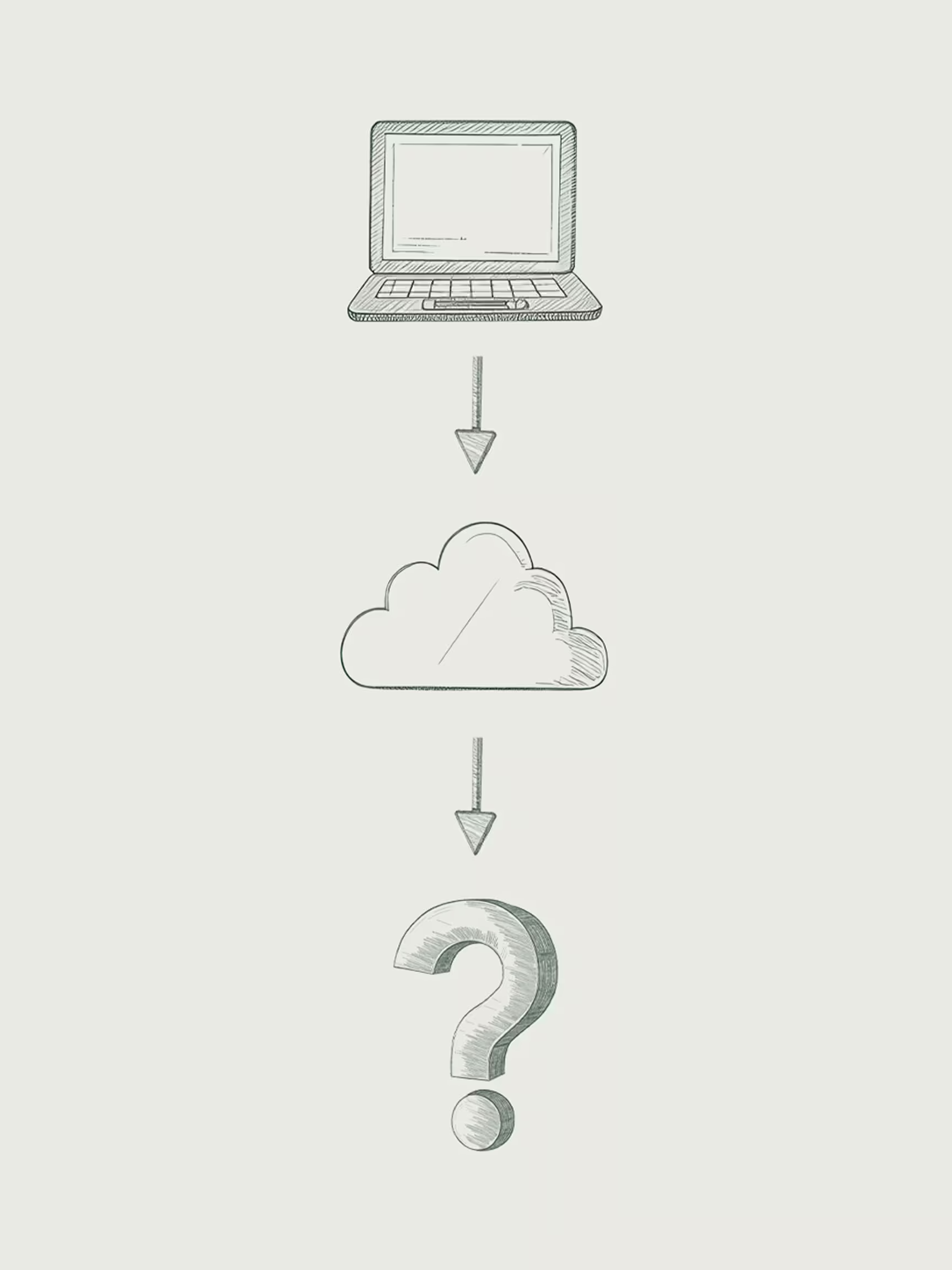
The most important distinction is that your data never leaves your infrastructure.
You consume intelligence through the pipe from whatever AI lab you choose, but your files, your methods, and your business logic stay local. Each API call sends only a small snapshot of context. In a multi-step agentic workflow, each step operates on minimal context, completes its task, and passes a result forward. It's closer to how microservices reshaped the cloud era: small, stateless, composable units of work. No single call requires exposing the whole picture.
The equation changes for every enterprise buyer. You can consume intelligence from the best available source, whether that's a frontier lab or your own fine-tuned open-source model behind your firewall. You build your methods within your own walls. You retain all your data. This restores the contract that held for six decades.
Overhyped product, underhyped pattern
Let me be precise about where I land, because the distinction matters.
The product itself is overhyped. OpenClaw has serious problems that 150,000 GitHub stars obscure. Major security firms have flagged severe vulnerabilities, including command injection exploits and malicious packages flooding its skill marketplace. Industry analysts have recommended against running it on enterprise devices. There's no SLA, no professional support, no governance layer. Employees are deploying it as shadow AI on corporate networks, creating security exposure that most IT teams aren't equipped to manage.
The critics have a sharper point, too. One AI researcher described it as "amazing hands for a brain that doesn't yet exist." The tool integration is genuinely impressive. But the underlying intelligence still has fundamental limitations. OpenClaw doesn't solve those. It just gives whatever brain exists better reach.
But the pattern OpenClaw represents? That's underhyped. Significantly so. The product may flame out, get acquired, or remain a hobbyist tool. What won't disappear is the model it proved: local-first agent runtime, intelligence consumed via API, data retained behind your walls. It challenges the hypothesis that AI agents must be vertically integrated. The right analogy isn't the iPhone. It's the Altair 8800: the hobbyist prototype that proved an approach works, not the product that won the enterprise market.
Why this transition was inevitable
The theory of disruptive innovation explains why AI v1 was always transitional. Early in any technology, vertical integration wins because interfaces aren't standardized, and performance isn't good enough. That's where AI was in 2023 and 2024. The labs controlled the models, the infrastructure, and the serving capacity. Nobody else could assemble the full stack.
But once interfaces standardize and "good enough" performance becomes widely available, the market disaggregates. That's happening now. Open-source models reach 90% of frontier performance at a fraction of the cost. Agent protocols are standardizing through open foundations. You don't need one company to own the whole stack anymore.
The contract restored
The technology industry has a six-decade habit of correcting back toward architectural sanity. Customers want the best infrastructure available. They want access to the most powerful capabilities. And they want to own their data, their methods, and their competitive advantage.
AI v1 broke that contract by asking enterprises to hand over everything in exchange for intelligence. The market tolerated it briefly because the intelligence was genuinely new. That tolerance is ending. OpenClaw, for all its flaws, proved that a different model works. Intelligence consumed through the pipe. Data and methods are retained behind your walls. Open, modular, and composable.
For builders reimagining how enterprises will consume AI, this is the model to bet on. Not because it's novel, but because it's the same approach that won every previous era of computing. The question isn't whether this transition happens. It's who builds the enterprise-grade version first.
.avif)